Wikoo - Voice Chat Party&Games
- 4.0
- Rating
- 50.00K
- Installs
- Free
- Price

 Analysis by App-foxy
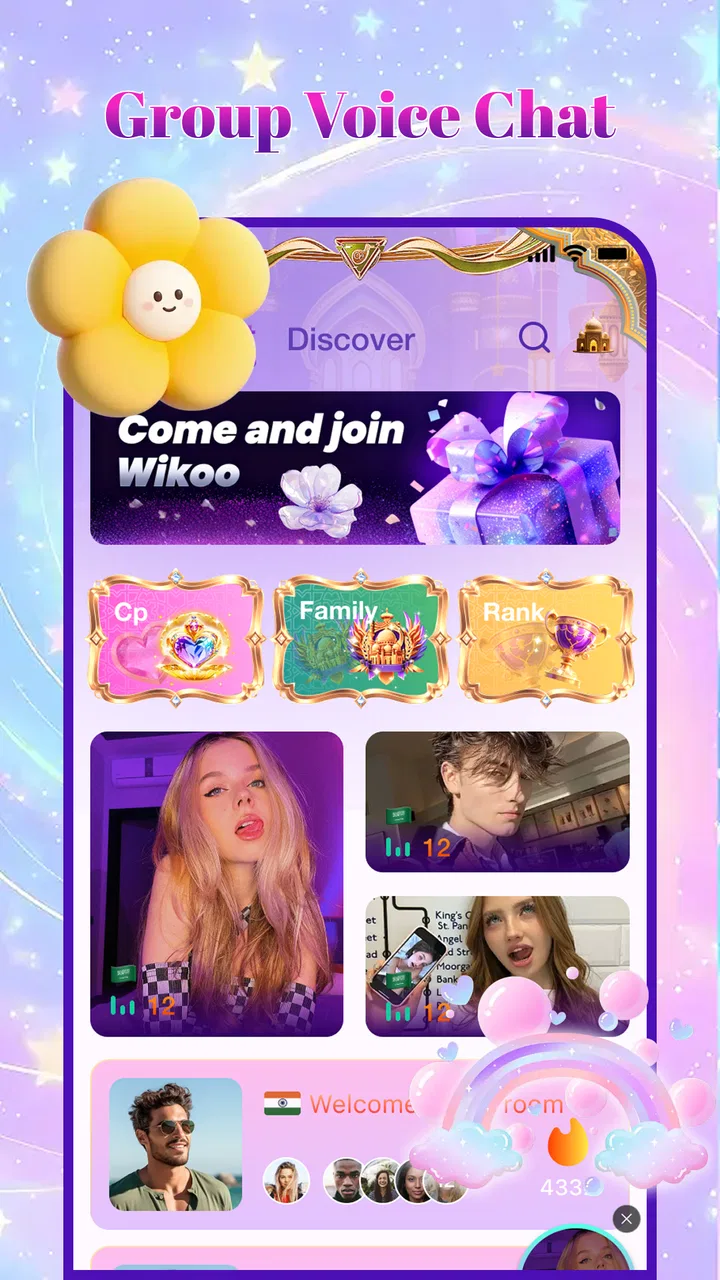
I found Wikoo - Voice Chat Party&Games most interesting as a social space for people who want conversation to feel more active than a normal messaging thread. It combines voice party rooms with games and the possibility of meeting people from different countries, so the appeal is less about one specific game and more about having somewhere to drop in, talk, and join an activity. I would describe it as a communication app with a playful, live-room atmosphere rather than a replacement for a private messenger.
That distinction matters in a household. If one person uses it on a shared phone or tablet, the experience can easily overlap with other family members’ accounts, notifications, and conversations. I would treat it as an individual social app, even when the device belongs to everyone. Its Mature 17+ rating is an important part of that decision, especially in homes where younger users may pick up the same device.
How Wikoo feels when used as a shared social space
In everyday use, I can imagine opening Wikoo after dinner when I want company without arranging a full call in advance. A voice room gives the interaction a more immediate feeling than sending messages, while the game element offers something to do when conversation slows down. That combination is useful for people who find ordinary chat apps too quiet or repetitive.
You May Also Like

 Blood Strike: 2.5 Anniversary
Blood Strike’s Loadouts Turn Every Drop Into a Tactical Gamble
A close look at Blood Strike’s custom loadouts: how fast access to signature weapons reshapes its battle royale rhythm, rewards preparation, and narrows the gap between fights.

 Pandora - Music & Podcasts
Pandora’s Music Is Easy to Start, but Harder to Recover
Pandora’s strength is its low-effort path from a seed to a station. Its weak spot is how much confidence it asks you to place in connection, setup, and quiet recovery.

 8 Ball Pool
 Is Built on Rivalries, Rematches, and Routine
A close look at the rivalries, rematches, shared routines, and unanswered safety questions that turn a quick pool match into a persistent mobile community.

 Samsung Music
’s Quiet Strength Is Playing What You Already Own
Its reach comes less from spectacle than from dependable access to a personal library. That simplicity is both the app’s strongest retention engine and its ceiling.

 AccuWeather: Weather Radar
AccuWeather Review: A Quick, Clear Forecast for Everyday Decisions
For everyday plans, the best forecast is the one you can understand quickly. AccuWeather makes rain timing, radar, and local conditions easy to act on, with a few trade-offs.

 Hill Climb Racing
Why Hill Climb Racing Still Turns Crashes Into One More Run
A tiny car, a bumpy hill and one more upgrade: Hill Climb Racing keeps resurfacing because its simple chaos makes every near-miss feel personal.
More From Our News Desk
View All News


A realistic household scenario would be one adult using a personal account on a family tablet while another person is nearby doing something else. The user can join a room, speak with others, and move between social interaction and play. However, I would not hand the device to a child simply because the app includes games. The games are part of a mature social environment, not a sign that the whole experience is suitable for children.
The strongest use case is casual connection. Wikoo makes sense when you enjoy meeting unfamiliar people, listening to several voices, and joining a room without needing to prepare a formal group call. It is less convincing if your main goal is a quiet conversation with one trusted contact, a work meeting, or a carefully managed family chat. Traditional messaging and calling tools remain better for those jobs because their purpose is clearer and their social boundaries are usually easier to understand.
I also see a useful role for friends who live in different places. A shared game can remove some of the pressure to keep a conversation going, particularly when people have different levels of confidence speaking in a second language. Still, an open social room can be unpredictable. The app’s worldwide angle is appealing, but it also means the tone and expectations of each room may vary considerably.
What the first setup should accomplish
My first recommendation is to decide whose account is being used before exploring rooms. On a shared device, signing into a social app casually can create confusion later: another person may assume the visible profile is theirs, or notifications may appear when someone else is holding the device. A separate personal device is preferable, but if that is not possible, I would at least make the account boundary clear to everyone in the household.
I would also avoid treating the app as a family-wide profile. Wikoo is built around personal social participation, and a single shared identity makes it harder to know who is speaking, who joined a room, or who should receive a reply. The practical rule is simple: one person, one account, and a clear habit of leaving the app when that person has finished.
Because the app is free to download and use, it is easy to start experimenting without a financial commitment. That does not mean every part of the experience is cost-free. The app includes in-app purchases ranging from fifty-one cents to five dollars and twenty cents per item. On a shared device, I would be especially careful about who can approve purchases and whether the person using the account understands that optional items can create charges.
This is one of the less obvious household trade-offs. The purchase range is not the main reason to choose or reject Wikoo, but it changes how I would introduce it to someone else. I would explain the difference between joining rooms and buying optional items before letting another household member explore the app. That short conversation prevents the common mistake of assuming that “free” means there is no payment path inside the app.
Keeping conversations and coordination manageable
Wikoo’s value depends heavily on how well you coordinate with the people you actually want to meet. If friends are using it at the same time, agreeing on a rough window is more useful than sending a vague message such as “join later.” Voice rooms are live by nature, so a little planning reduces the chance that one person arrives after everyone else has left.
I would use a separate everyday messenger for arranging the meeting and Wikoo for the room itself. That gives the household or friend group a simple division of labor: private messages handle time and logistics, while Wikoo handles the shared voice experience and game session. It is a more reliable workflow than expecting every participant to discover the same room by chance.
For a family sharing a device, coordination also means agreeing on when the app is appropriate. A person may be speaking in a room while another household member expects to use the tablet for a call or schoolwork. Since voice interaction is active and attention-heavy, I would reserve a predictable time and use headphones when possible. This is not a special Wikoo feature; it is a practical way to prevent a social app from taking over a shared space.
One useful habit is to decide whether the goal is conversation or play before joining. If the group mainly wants to talk, moving between game-focused rooms may create unnecessary distraction. If the group wants an activity, choosing a room with a clear shared purpose should make the session feel less awkward. The app’s combination of voice and games is flexible, but that flexibility works best when participants have similar expectations.
I would also be cautious about using Wikoo as the only way to coordinate an important event. A live room can be enjoyable for informal plans, but it is not the right foundation for appointments, urgent family updates, or anything that requires a guaranteed written record. For those situations, a conventional messaging app or phone call is more dependable.
Age, trust, and the meaning of the Mature 17+ rating
The Mature 17+ rating should shape how I recommend Wikoo. I would not interpret the presence of games as an invitation for younger children, and I would not assume that a parent’s presence beside the device changes the app’s intended age context. The social nature of voice rooms means users may encounter conversations and personalities that are not appropriate for every member of a household.
This is especially important on a shared tablet. If an adult has used Wikoo and then leaves the account open, a younger person may be able to enter the same environment without understanding the risks of speaking with strangers. My practical approach would be to close the app after use, avoid leaving a personal account visible, and keep the app associated with the adult user who chose to install it.
Trust also matters between participants. Meeting people worldwide can broaden the experience, but a friendly voice is not the same as a verified identity. I would avoid sharing a home address, school details, workplace information, private contact details, or family routines with someone met in a room. That advice is particularly important when a shared device makes it easy for another household member to overhear a conversation without knowing who the speaker is.
For adults, the rating is a reminder to choose rooms thoughtfully rather than entering every available space. I would leave a room if the tone becomes uncomfortable, if someone pressures me to reveal personal information, or if the conversation no longer matches why I joined. The app is more enjoyable when I treat room selection as an active decision instead of assuming every room will offer the same atmosphere.
Parents or guardians considering Wikoo for an older teenager should discuss account ownership, spending, room etiquette, and personal boundaries first. The important point is not to invent a safety promise the app does not make. Instead, the household should decide whether the teenager is mature enough to manage live conversations and optional purchases responsibly. If that answer is uncertain, I would choose a more controlled communication option.
Where it fits beside ordinary communication apps
Compared with a standard text messenger, Wikoo feels more spontaneous and social. Text apps are usually better when I need a searchable record, a private exchange, or a quick logistical note. Wikoo is more appealing when I want voices, a shared activity, and the possibility of joining a broader community rather than speaking only with people already in my address book.
Compared with a conventional voice-call app, its game-and-room format gives the interaction a lighter structure. A normal call can be more efficient for two people who already know exactly what they want to discuss. Wikoo has more discovery built into the experience, which is a strength for outgoing users but a weakness for anyone who dislikes unfamiliar groups or unpredictable conversation.
It also differs from a dedicated gaming communication service. A gaming-focused tool may be preferable when a fixed team needs dependable coordination around a particular title. Wikoo’s appeal is broader: the social room itself is part of the activity, and the games support the conversation rather than defining a serious competitive setup. I would choose Wikoo for casual participation, not for organized team performance.
That comparison leads to a useful decision rule. Choose Wikoo when you want live social energy and do not mind meeting people outside your existing circle. Choose a private messenger when privacy, continuity, and direct contact matter more. Choose a dedicated gaming tool when your group already has a specific game, schedule, and communication routine.
Practical friction I noticed in the concept
The same openness that makes Wikoo interesting can also make it tiring. Voice rooms demand more attention than text, and not everyone enjoys speaking with several people at once. If you prefer to read and respond at your own pace, the live format may feel intrusive rather than welcoming.
There is also a social learning curve. A room can be easy to enter but harder to join naturally, especially when existing participants already know one another. I would give the app a fair trial across more than one session before deciding it is not for me, but I would not force myself to stay in a room that feels uncomfortable. The best experience depends on finding a group whose pace and tone fit.
Shared-device use adds another layer of friction. Audio can interrupt other activities, profiles can be mistaken for one another, and purchase decisions become a household matter instead of a purely personal one. These are not reasons to avoid the app altogether, but they make it a poor fit for a device that is constantly passed between children and adults without clear usage rules.
The app comes from Asif Infotech and currently carries a 4.0 average from around 777 ratings, with more than 50 thousand installs. Those figures suggest that it has found an audience, but I would still read the rating as a sign to set realistic expectations rather than as proof that every room will suit every user. Social apps are unusually dependent on timing, room culture, and the people active when you open them.
Who should try it, and who should skip it
I would recommend Wikoo to an adult who enjoys casual voice interaction, wants games to break the ice, and is comfortable meeting people beyond an existing friend group. It is also worth considering for friends who want a relaxed shared activity without committing to a formal call. The free entry makes experimentation straightforward, provided everyone understands the optional purchase path.
I would be more cautious recommending it to someone who wants a private family communication channel. The Mature 17+ context and live social-room design do not match the needs of a child-focused household app. I would also steer away from it if the main requirement is strict organization, a permanent written history, or professional reliability.
People who dislike speaking with strangers may find the worldwide community more stressful than exciting. Likewise, anyone who expects a game platform centered on one deep title may be happier with a dedicated service. Wikoo is at its best when the conversation and the social discovery are the main event, with games adding momentum rather than serving as the entire reason to open the app.
Version, access, and my household verdict
The current version is 1.8.10, and the app works on Android 8.0 or later. That makes checking the device’s operating-system compatibility a sensible first step before planning a shared installation. I would also confirm that the device has a suitable microphone and a comfortable way to handle voice audio, because those basics matter more here than they would in a text-only app.
After using the concept as a household decision rather than just a download choice, my verdict is measured but positive. Wikoo can be a fun addition for the right adult user: someone who wants to enter a lively voice room, meet people from different places, and use games to make interaction less formal. Its biggest strength is the blend of live conversation and casual activity; its biggest responsibility is managing who uses it and how.
I would install it for a clearly identified adult account, explain the age context, keep purchase expectations visible, and use another app for private coordination. I would not leave it signed in on a device used freely by children, and I would not present it as a substitute for a private family messenger. With those boundaries in place, Wikoo has a genuine place in the communication category: not as an all-purpose tool, but as a social meeting room for people who enjoy voice, games, and a little unpredictability.
For my own recommendation, that is the deciding point. If you want a controlled, private, practical communication channel, choose the usual alternatives. If you want a more open evening hangout and are prepared to manage age, account, and spending boundaries, Wikoo is worth trying. Use it as a personal social space, not as an unmanaged shared-device app.
FAQs for Wikoo - Voice Chat Party&Games
01What is Wikoo - Voice Chat Party&Games?
Wikoo is a social entertainment app focused on live voice communication, party-style interaction, and casual games. After opening the app, users can explore voice rooms, join conversations, meet other participants, and take part in game-based activities. It is designed more for socializing and entertainment than for private messaging, so the experience depends heavily on the available rooms and active community members.
02Do I need to create an account to use Wikoo?
Wikoo may allow you to browse part of the platform before signing in, but an account is generally required for meaningful participation. Registration can unlock voice rooms, profiles, social features, games, and communication tools. Before creating an account, review the permissions requested and the available sign-in methods. Avoid sharing sensitive personal information publicly, especially in open voice rooms with people you do not know.
03Is Wikoo safe for children and teenagers?
Parents should approach Wikoo carefully because live voice chat and public social rooms can expose younger users to unknown participants, unsuitable language, or unwanted contact. The app may include reporting, blocking, or moderation tools, but these should not replace supervision. Check the current age rating, privacy policy, and parental-control options before installation, and encourage minors never to share their real name, location, school, or private contact details.
04Does Wikoo cost money to use?
Wikoo can typically be downloaded without an upfront purchase, but some social features, virtual items, premium content, or in-app activities may involve optional payments. Pricing and available purchases can change by region and platform. If children use the app, enable purchase restrictions through Android or iOS settings. It is also worth checking whether voice rooms or games consume significant mobile data when used away from Wi-Fi.
05What permissions and internet connection does Wikoo require?
Because Wikoo is built around live voice interaction and online games, it normally requires a stable internet connection and may request microphone access. The microphone permission is necessary for speaking in voice rooms, while other permissions can vary depending on the installed version and device. Grant only permissions that make sense for the features you use, and remember that continuous voice communication may affect battery life and mobile-data usage.
Pros
- Quickly join voice rooms and meet people with shared interests.
- Interactive games help keep conversations lively and engaging.
- Supports casual socializing without requiring lengthy profile setup.
- Room-based chats make it easy to discover new communities.
- Frequent activities can make the app feel dynamic and entertaining.
Cons
- Public voice rooms may include loud
- disruptive
- or inappropriate users.
- Finding genuinely meaningful conversations can take time.
- The experience depends heavily on active rooms and available users.
- Some features or virtual items may require in-app purchases.
- Voice chat can consume noticeable battery and mobile data over time.

Wikoo - Voice Chat Party&Games
Gallery